When selecting a valve for industrial piping systems, one of the most important considerations is the connection type. Three of the most common valve connection styles are Lug Type Valves, Wafer Type Valves, and Flange Type Valves.
Each design offers unique advantages depending on the application, piping arrangement, maintenance requirements, and operating conditions.
What is a Lug Type Valve?
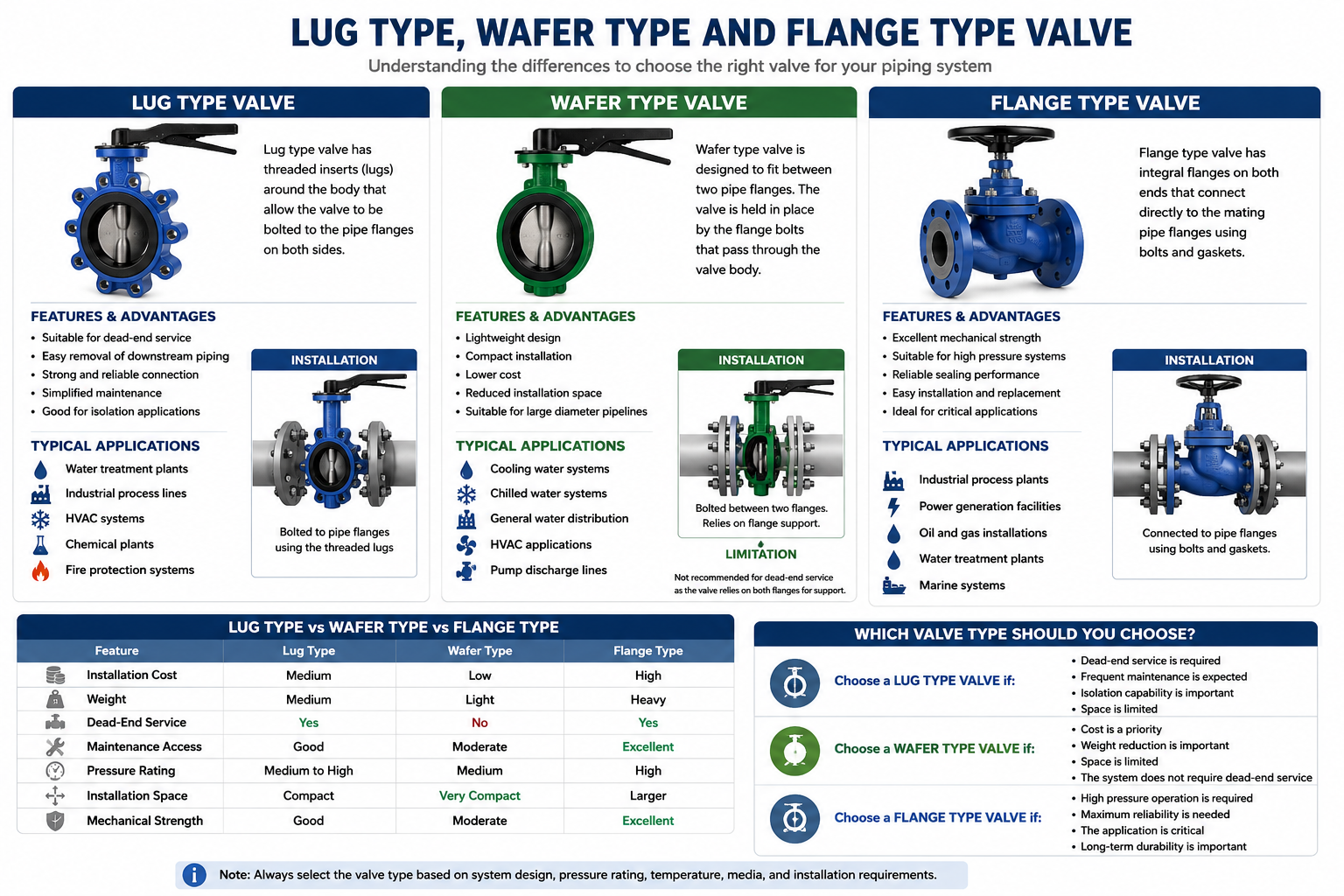
A Lug Type Valve features threaded inserts (lugs) around the valve body, allowing the valve to be bolted directly to pipe flanges on both sides.
Advantages of Lug Type Valves
- Suitable for dead-end service
- Easy removal of downstream piping
- Strong mechanical connection
- Simplified maintenance
- Good for isolation applications
Typical Applications
- Water treatment plants
- HVAC systems
- Industrial process lines
- Chemical plants
- Fire protection systems
Common Lug Type Valves
- Butterfly Valves
- Knife Gate Valves
- Check Valves
What is a Wafer Type Valve?
A Wafer Type Valve is designed to fit between two pipe flanges and is secured using flange bolts that pass through the entire assembly.
The valve body itself does not contain threaded mounting holes.
Advantages of Wafer Type Valves
- Lightweight design
- Compact installation
- Lower cost
- Reduced installation space
- Suitable for large diameter pipelines
Typical Applications
- Cooling water systems
- Chilled water systems
- General water distribution
- HVAC applications
- Pump discharge lines
Common Wafer Type Valves
- Butterfly Valves
- Check Valves
- Dual Plate Check Valves
Limitations
Wafer valves are generally not recommended for dead-end service because the valve relies on both flanges for support.
What is a Flange Type Valve?
A Flange Type Valve features integral flanges on both ends that connect directly to mating pipe flanges using bolts and gaskets.
This is one of the strongest and most robust valve connection methods available.
Advantages of Flange Type Valves
- Excellent mechanical strength
- Suitable for high pressure systems
- Reliable sealing performance
- Easy installation and replacement
- Ideal for critical applications
Typical Applications
- Industrial process plants
- Power generation facilities
- Oil and gas installations
- Water treatment plants
- Marine systems
Common Flange Type Valves
- Gate Valves
- Globe Valves
- Ball Valves
- Butterfly Valves
- Check Valves
Lug Type vs Wafer Type vs Flange Type Valve
| Feature | Lug Type | Wafer Type | Flange Type |
|---|---|---|---|
| Installation Cost | Medium | Low | High |
| Weight | Medium | Light | Heavy |
| Dead-End Service | Yes | No | Yes |
| Maintenance Access | Good | Moderate | Excellent |
| Pressure Rating | Medium to High | Medium | High |
| Installation Space | Compact | Very Compact | Larger |
| Mechanical Strength | Good | Moderate | Excellent |
Which Valve Type Should You Choose?
Choose a Lug Type Valve if:
- Dead-end service is required
- Frequent maintenance is expected
- Isolation capability is important
- Space is limited
Choose a Wafer Type Valve if:
- Cost is a priority
- Weight reduction is important
- Space is limited
- The system does not require dead-end service
Choose a Flange Type Valve if:
- High pressure operation is required
- Maximum reliability is needed
- The application is critical
- Long-term durability is important
Common Industries Using These Valve Types
These valve connection styles are commonly found in:
- Water Treatment Plants
- Wastewater Treatment Facilities
- HVAC Systems
- Marine Applications
- Power Plants
- Manufacturing Facilities
- Chemical Processing Plants
- Oil & Gas Facilities
- Building Services Systems
Conclusion
Lug Type, Wafer Type, and Flange Type Valves all serve important roles in industrial piping systems. The best choice depends on your pressure requirements, maintenance strategy, installation space, and budget.
For most HVAC and water transfer systems, wafer valves provide a cost-effective solution. For isolation applications, lug valves offer greater flexibility. For high-pressure and critical services, flange type valves remain the preferred option.